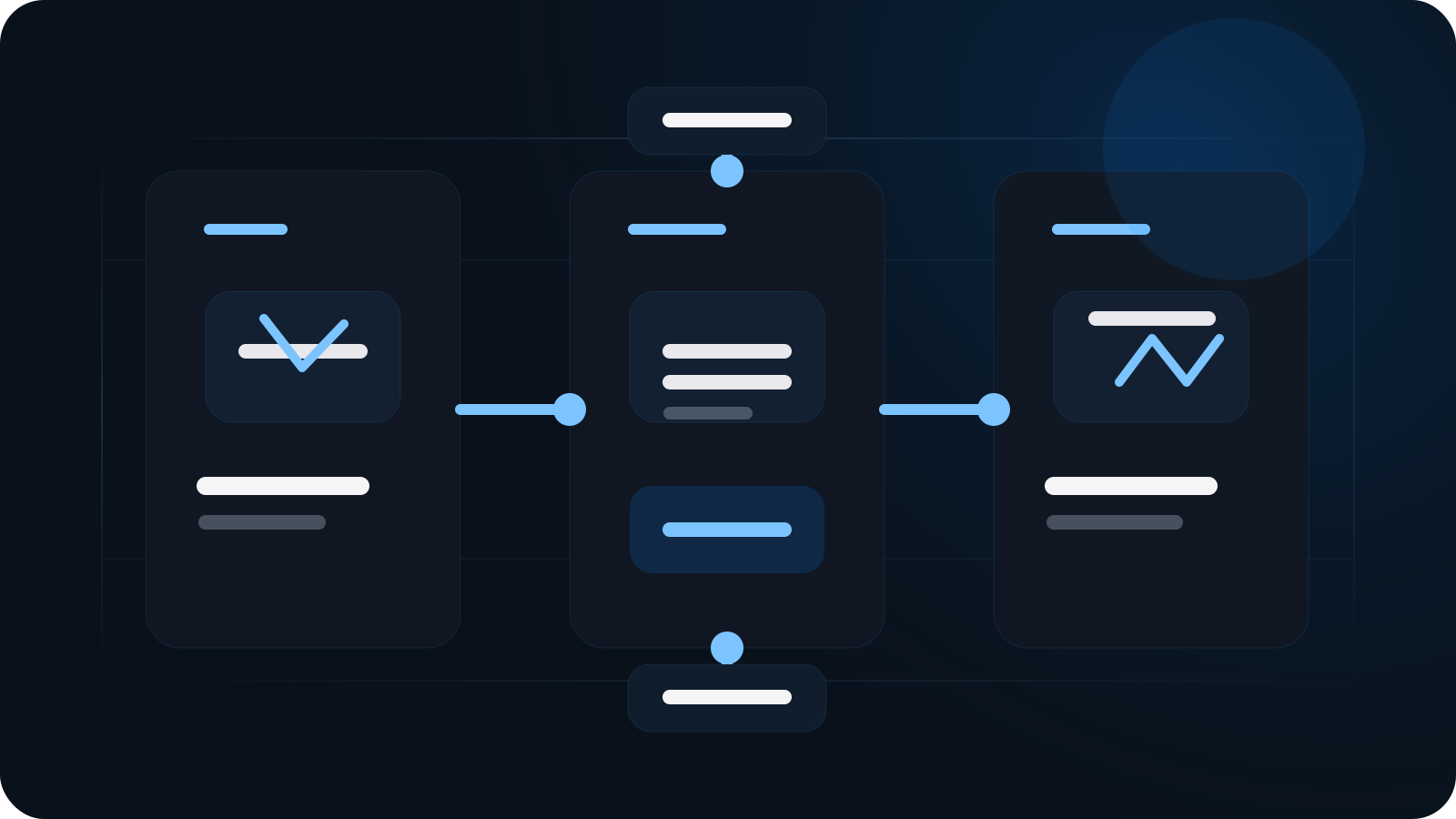
Cloud is often the fastest path to learning
It reduces infrastructure friction and gets teams into the value-testing phase faster.
On-premise is usually a control conversation
It becomes compelling when data sensitivity, integration boundaries, or governance needs are serious.
Hybrid often reflects business reality best
Many organizations need cloud intelligence with private execution or internal data boundaries.
Architecture choices should expose costs, not hide them
The right model is the one whose operational tradeoffs stay visible over time.
The wrong way to start is with ideology
We have seen teams come into deployment discussions already attached to a label. Some want everything on-premise because it feels safer. Others want everything in the cloud because it feels faster and more modern. Both instincts are understandable, but neither one is a strong architecture method on its own.
A deployment model should come out of the business constraints, not out of a preferred identity. The moment you anchor the decision to ideology, you start ignoring the details that actually determine whether the system will be usable, supportable, and economically sane.
Cloud, on-premise, and hybrid are not personality types. They are operating choices.
Cloud gets you moving faster for a reason
There is a reason cloud is often the first step. It is easier to provision, easier to iterate on, and easier to connect into modern model ecosystems. If a team is still learning where the value is, cloud can reduce the friction of experimentation dramatically.
That matters in early-stage deployments because speed is not just convenience. Speed helps the business test the use case, learn how people actually interact with the system, and discover where the real bottlenecks are before over-investing in infrastructure.
- Faster to launch and iterate.
- Lower infrastructure burden at the beginning.
- Access to strong model and tooling ecosystems.
- Better fit when workloads are still changing quickly.
On-premise usually becomes attractive when control becomes non-negotiable
When a team asks for on-premise, the real issue is often not nostalgia or resistance to the cloud. It is usually one of four things: data sensitivity, system boundaries, latency requirements, or governance constraints.
In those environments, keeping more of the system close to internal infrastructure can be the right call. But it only stays the right call if the organization is also realistic about what it is taking on: more operational responsibility, more infrastructure management, and more design pressure to keep the system maintainable.
- Sensitive data cannot move freely.
- Critical systems are hard to expose externally.
- Local execution matters for latency or resilience.
- Governance requirements are strict enough to shape the architecture.
Hybrid is often what the business was really asking for all along
A lot of organizations do not actually need to choose one side fully. They need cloud reasoning, external model access, or flexible orchestration in one part of the stack, while keeping retrieval, execution, records, or private data handling in another environment.
That is why hybrid often emerges as the most practical answer. It mirrors the fact that businesses already operate across multiple environments, multiple systems, and multiple control boundaries. Good hybrid design acknowledges that reality instead of pretending the stack is simpler than it is.
Hybrid is not a compromise when the business itself already runs in a mixed environment. It is often the most honest design.
Most cost surprises come from architecture drift
One of the quieter risks in AI deployment is that costs become visible only after the system becomes useful. Cloud usage grows, request volume expands, retrieval patterns change, or the team adds monitoring and support overhead that was never modeled clearly. The same thing happens on-premise in a different form when infrastructure and operational support costs start accumulating outside the original proposal.
That is why we prefer architecture decisions that make cost legible. If the business cannot understand what drives the long-term run cost of the system, it is too easy for a promising deployment to become something leadership starts questioning later.
- Estimate steady-state workload, not just pilot workload.
- Separate build cost from run cost.
- Track costs at the workflow or use-case level when possible.
- Make monitoring part of the cost model, not an afterthought.
A better rollout path is usually staged, not absolute
We generally do not think teams need to lock the final deployment model on day one. A better move is often to choose the lightest architecture that can validate the use case, then harden the stack where the business case truly demands it.
That could mean starting in the cloud, moving sensitive retrieval inward later, or designing a hybrid boundary from the beginning so the system can evolve without a painful rewrite. The important thing is not to guess perfectly at the start. The important thing is to design a path that can mature with the business.
The strongest deployment decision is usually the one that makes the business easier to operate, easier to govern, and easier to understand over time.
When we evaluate deployment strategy, we try to make the tradeoffs visible early. That keeps the conversation honest and usually leads to an architecture the business can actually grow with.